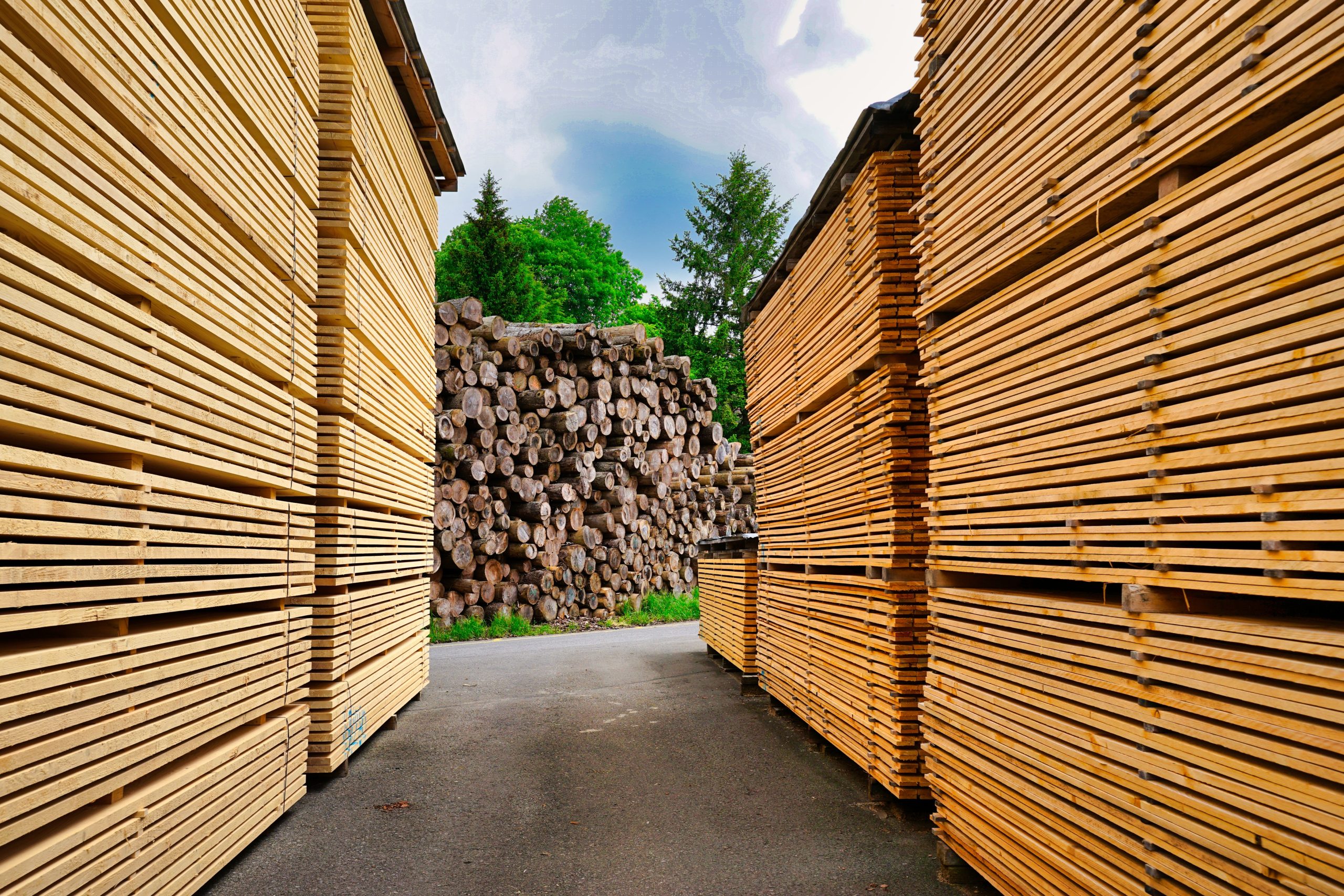
Sawmilling – as old as the hills, unglamorous and rarely in the news. It is however an exemplar of resource efficiency, from which many sectors could learn. Why? Because virtually nothing is wasted, everything has a value and a market. That’s partly due to the versatility of timber, but largely out of necessity. Timber is a low value product, so maximising resource efficiency is a must for financial viability.
Let’s go through the process:
- The efficiency starts in the forest, where trees are cut to length according to the desired end use. For example, 2.4 m, a common length for construction timber.
- At the sawmill, first the bark is stripped off and then shredded for use as a landscaping material.
- The debarked log is then 3D scanned and a computer programme will determine what products can be cut from it to maximise its yield.
- To make square section products from a round log, the sides are cut off and then chipped, increasingly for boiler fuel, if not landscaping.
- As the now square section timber is cut into products, the sawdust and chips are collected and then marketed as equine bedding, or increasingly used to make wood fuel pellets or briquettes, often on-site.
Virtually nothing goes to waste during this process, everything has a value and a market.
So what can other manufacturing businesses learn from sawmilling?
That will be very much sector dependant, but the principles of maximising resource efficiency, finding new markets, being flexible and developing a broad product range are common.
It often takes a fresh pair of eyes to spot inefficient use of materials, or opportunities to turn a ‘waste product’ into a ‘co-product’.