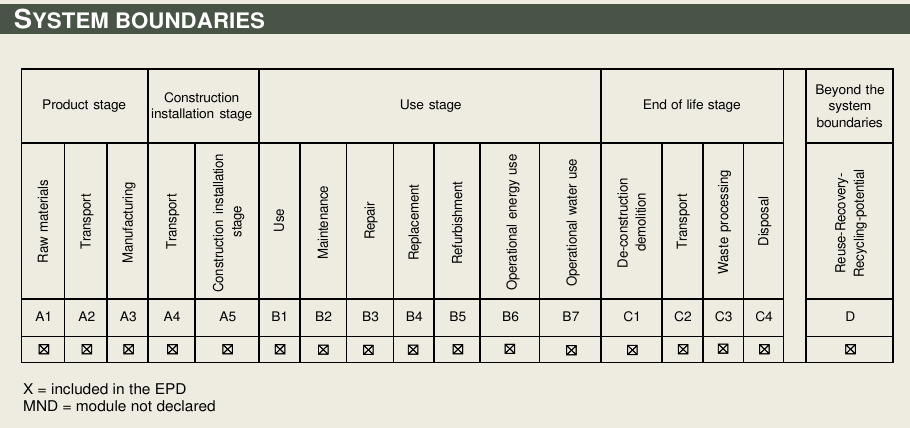
An EPD is based on a Life Cycle Assessment (LCA) and provides information on resource consumption, energy use, waste generation, pollution risk and carbon emissions of a specific product, from a bag of cement to a complete car. EPDs are widely used in the construction industry to inform Whole Life Carbon Assessments (WLCA) of buildings and infrastructure.
For any business reporting its Scope 3 carbon emissions, EPDs provide definitive and accurate carbon emissions data on the goods and materials that it purchases. They are not yet universally available, but we’re seeing more and more.
Providing EPDs is a new service for us, so here’s a quick explanation.
EPDs help quantify the environmental impact of a product by considering all stages of its life cycle.
EPDs are standardized to ensure consistency and comparability across different products and materials, as per EN 15804, ISO 14025, and other relevant international standards.
- Life Cycle Assessment (LCA):
The data in an EPD is derived from an LCA, which analyses the environmental effects of a product from “cradle to grave”.
EPDs provide information on various environmental indicators, including resource consumption, energy use, waste generation, and emissions to air, water, and soil.
EPDs are a key input for Whole Life Carbon Assessments (WLCA) of buildings, helping to understand the overall carbon footprint of a project.
EPDs promote transparency and environmental accountability, encouraging companies to improve their products’ sustainability. They are also used for green procurement and certification schemes.
Independent third-party verification ensures the accuracy and reliability of the EPD, making it a credible tool for environmental decision-making.
An EPD is valid for four years.